Sunday, February 20, 2011

Fanta Icy Lemon

Canned Icy Lemon at Dublin Castle.

So admittedly, this post has been quite belated. I intended to post the remaining sodas as soon as I returned, but things got busy and lasted through the holidays.

I've discussed Fanta's history in some length in prior postings. So, getting to the point... I was able to find the Icy Lemon flavor in Ireland. This was a tart little soda, with the refreshing flavor of fresh lemonade but with the added frostiness you would expect from foods labeled icy. The frost-flavoring doesn't overwhelm the lemon and unlike some drinks didn't make me sick to my stomach by the end. Great refresher on a nice day outside.

Bottled Icy Lemon in a Belfast bar.

Sunday, October 17, 2010

Fanta Fruit Twist

Here's another Fanta flavor that isn't offered in the states so far as I can tell. I assumed that this would be fruit punch flavored but was surprised to find that this lightly carbonated drink tastes strongly of pink grapefruit. It is tart and besides the grapefruit taste I sense something along the line of mango or tangerine as in a subtle background flavor. If you like citrus sodas you'll probably enjoy this and it's another good breakfast soda.

Thursday, October 14, 2010

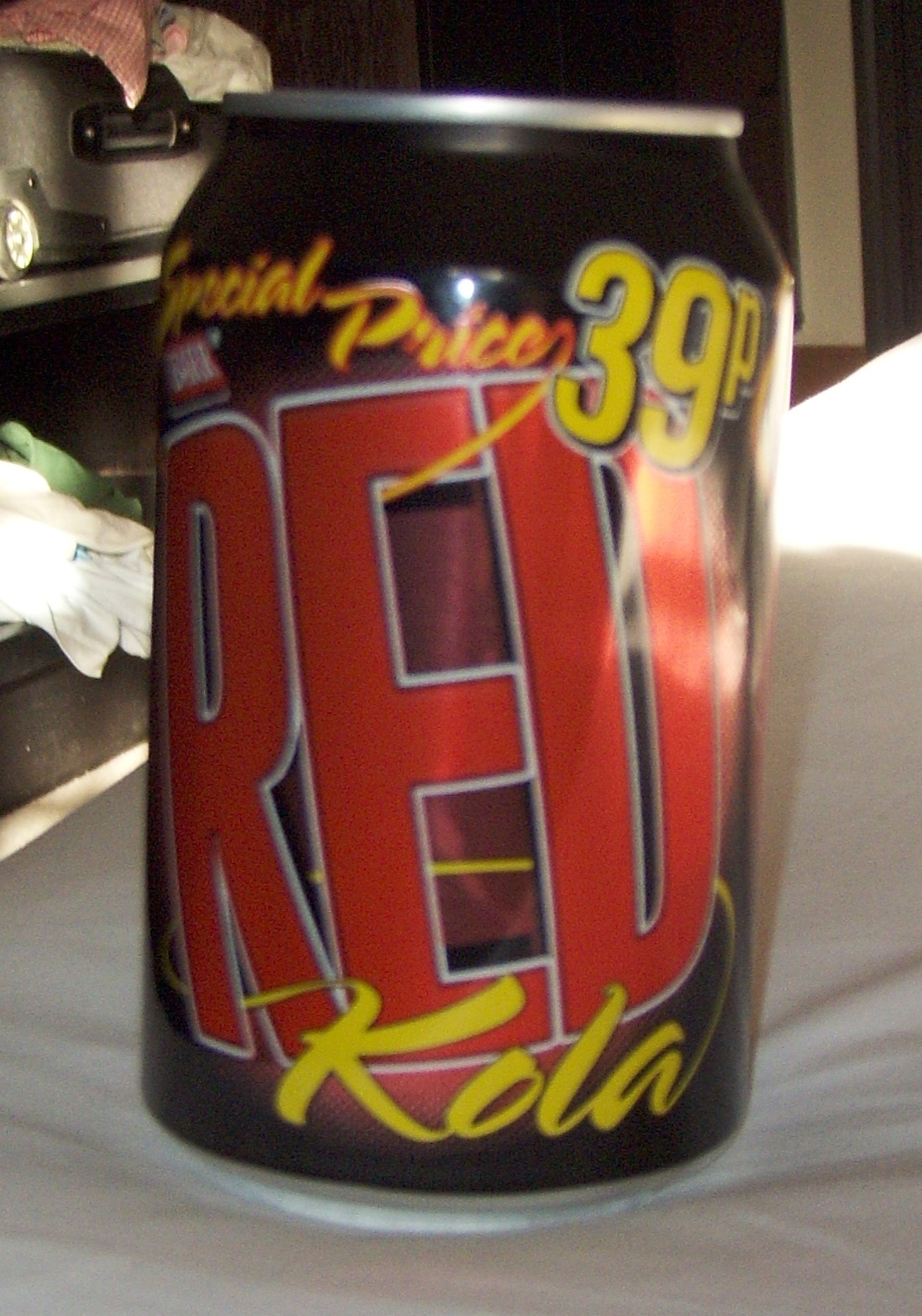
Red Kola

Barr, which also makes Irn-Bru, produces this beverage typically found in the British Isles like their other drinks. I was expecting a cola flavored drink with a touch of cream soda taste added. Rather this is a pink/red colored liquid closer to the red cream taste of Big Red. But it's cheap and found in manly places around Scotland so of course I had to give it a go.

Monday, October 11, 2010

Irn-Bru

Because I'm traveling I've decided to make some entries as I go and input pictures and info later. At the moment I am riding the Stena Ferry from Belfast to Straener. I've been able to locate a bottle of Irn-Bru in the ferry's shop for the purposes of this blog.

Irn-Bru has been produced since 1901 and since that time has always contained actual iron in the beverage. This is a taste you will notice when drinking it. The distinct flavor of this drink can be best described as a metallic cream soda. It is bright orange in color with a decent level of carbonation. The drink has a secret recipe stored in Switzerland. This isn't a favorite drink of mine and I would probably prefer it mixed with vodka.

Monday, September 13, 2010

Nehi Grape

In 1905, a pharmacist named Claude Hatcher founded the Union Bottling Works in Columbus, Georgia. Claude's company focused primarily on the production of his sodas Chero-Cola and Royal Crown Ginger Ale. Due to the popularity of Chero-Cola, the company changed its name to the Chero-Cola Company in 1912. 

By 1924, Chero-Cola Co released a line of flavored sodas under the name Nehi. While the name conjures something of an asian origin to my mind, lore holds that it had a more folksy beginning. There is more than one story, but the two major myths basically boil down to calling the competition "knee-high" in how they compared to their drink. The Nehi line up at the time included orange, grape, peach, and root beer. By 1928, Nehi drinks were outselling Chero-Cola and so the company again changed names to the Nehi Corporation. 

Nehi suffered from the Great Depression like most other companies and operated at a loss in 1932. When Claude Hatcher died in 1933, the new president of the company became H.R. Mott. H.R. Mott led the development of a new cola beverage and borrowing a concept from Hatcher, named the drink Royal Crown Cola. Never ceasing to ride waves of popularity the Nehi Co. changed its name again in 1955 to the Royal Crown Company. The company was later brought under the umbrella of Snapple, which was later acquired by Cadbury Schweppes Inc. which spun it off to the control of by the Dr Pepper Snapple Group. Although Nehi can still be found today in some flavor variations, I doubt it is possible to still find it in glass bottles.

Perhaps Nehi is most well known from M*A*S*H, the television series which ran from 1972-1983 about an army surgical group in Korea. The character "Radar" O'Reilly was obsessed with Grape Nehi on the show. 

This bottle has a nearly non-existant level of carbonation, but a pleasant sugary, grape aroma. It has a sweet grape flavor like most modern American fruit-flavored sodas but isn't quite as overly rich as, say, a Welch's or the older Crush Grape which can sometimes make you sick by the end of a bottle.

Thursday, September 9, 2010

Virgil's Diet Root Beer

Virgil's began in the early 90's as an independent microbrew soda by the Crowley's. It was sold in 1999 to Reed's Inc. who produce the Virgil's line up of flavors in the Los Angeles area. The flavor line up has grown over the years from Root Beer to include various cream sodas. 

While Reed's Inc. does "brew" it's sodas using old-fashioned methods adapted to modern machinery, they also claim to use authentic ingredients from all over the world. Of this I cannot speculate, but whether or not that makes for a better soda can be debated. I can attest to having had other "premium" or "micro-brewed" sodas that sometimes fail to impress. Although, due to using "all-natural" ingredients you'll generally find Virgil's beverages next to Reed's sodas in grocery store health food/organic food sections.

While most Virgil's sodas use cane sugar, because this is their diet version it is sugar free, but contains Stevia extract as a sweetener. It's only lightly carbonated. It surely tastes like a diet with a different flavor. Unfortunately I did not have the regular diet available to compare, but will have to locate some in the future. The birch flavoring is strong. It leaves a lingering after taste and strangely seems to have a small numbing sensation on my tongue, perhaps from the wintergreen. All in all, for a diet root beer it isn't too bad, but I prefer others. Look for my future post on the non-diet Virgil' Root Beer.

Wednesday, September 8, 2010

Americana Black Cherry

The Americana range of sodas is produced by Orca Beverages, who also bottle several of the older style sodas and names. The Americana line is small batch brewed using cane sugar. Other than the fact that they began in 1995 out of Washington state there isn't much out there on them.

This flavor opens with a sharp release of carbonation and the rich aroma of black cherries. The best part of this drink is right after it touches your tongue. The pleasing full cherry taste quickly deteriorates after that. I don't find it to finish cleanly either, with a slight residual cling of syrup in your mouth. It's not a bad drink, but it's nothing to remember either.

Sunday, August 22, 2010

Sun Drop

Charles Lazier created the original Sun Drop recipe in St. Louis, MO in 1928, which his son, Charles Jr. developed into the Sun Drop soda that made it's debut in 1930. The beverage was known for having a distinct citrus flavor and a hefty dose of caffeine. Also known as Sun Drop Golden Cola or Golden Girl Cola, the Crush brand purchased Sun Drop in 1970. Crush was later bought by Proctor & Gamble, then sold off to Cadbury Schweppes which later spun off the Dr Pepper Snapple Group that also makes Dr Pepper, Crush, Hires, Nehi, A&W, Stewart's, Diet Rite and Squirt.

Sun Drop has only a light citrus scent and light, tiny-bubbled carbonation. The "pulp" is so minor as to be very hard to see, but noticeable when the bottle is up-turned. The flavor is not too in-distinct from that of Ski. This is that hard to describe blend of citrus flavors that isn't exactly grapefruit, lemon or lime, just a refreshing blend of citrus-nous.

Friday, July 30, 2010

Dad's Old Fashioned Root Beer

Dad's Old Fashioned Root Beer was created in 1937 by Ely Klapman and Barney Kerns in the basement of Ely Klapman's home in Chicago. This drink grew quickly in popularity in the American Midwest and in the 1940's was the first drink sold in six-pack format. During the 1940's the brand was sold as a "family" of sizes with the Papa being a full half-gallon bottle. Dad's was purchased by the Monarch Beverage Company, of Atlanta, in 1986.  In 2007 the beverage returned to it's Midwestern roots when it was purchased by Hedinger Brands, based in Jasper, Indiana. Like many drinks with regional beginnings you can find loyal Dad's fans around the Midwest.

This soda is caffeine free and made with cane sugar, and yes, bottled in Jasper, IN. It has a pleasing, old-fashioned root beer fragrance. As much as I was hoping to like this root beer, I found it to have a distinct chemical overtone to it. I found it to be too much for me to enjoy sipping it.

Monday, July 26, 2010

Sunkist

Sunkist as a brand name dates back to the turn of the 20th century when a co-op of citrus growers, called the Southern California Fruit Exchange, began branding it's fruit in 1908 as "Sunkist," alluding to it's high-quality. This is said to be the first time fruit was branded. Over time the co-op and the brand grew, including fruits other than oranges and even nuts. The co-op changed names later to the California Fruit Growers Exchange and later Sunkist Growers, Inc.

In 1977, General Cinema Corporation was also a Pepsi bottler. To fill out their range of soda offerings General Cinema wanted an orange beverage and so developed it's own concoction and licensed the "Sunkist" brand name from Sunkist Growers. Sunkist, the soda, was released on the public in 1978 and was the best-selling orange soda in the US two-years later.

It's actually surprising to me that a non-profit like the Sunkist Growers, who used their "Sunkist" branding as a sign of their high-quality, fresh fruits, would sell-out to General Cinema who use no oranges in making their drink, but rather citric acid, high-fructose corn syrup, and sodium citrate.

True, it's become this neon-orange which Americans see as the very symbol of "orange" and "freshness" over the duller colors of more natural orange drinks. And it does indeed have the aroma of a fresh orange rind. It has a good deal of carbonation and a tang flavor. But it's sodas like this and Fanta which are the par for the orange soda taster.